Acknowledgements (thesis extract)
“An endeavour such as this, a PhD thesis, particularly one that talks continually of bringing people together cannot be accomplished without the contributions of many, many people. To those who have assisted in any way, however tangentially it seemed at the time, I am very grateful. I am, of course, indebted to supervisory commitment, including that of the review panels. And, in the manner of complex adaptive systems, off-hand comments along the way had, in many cases, as much effect as hours of earnest conversation. On a practical note, […] initial graphics input provided a platform for the invaluable in-house (Visionary Design Development Pty Ltd) diagramming assistance rendered by Michelle Kelly.
But, this work is dedicated to the late Ralph Green (d. 2016), my soulmate of over 38 years.”
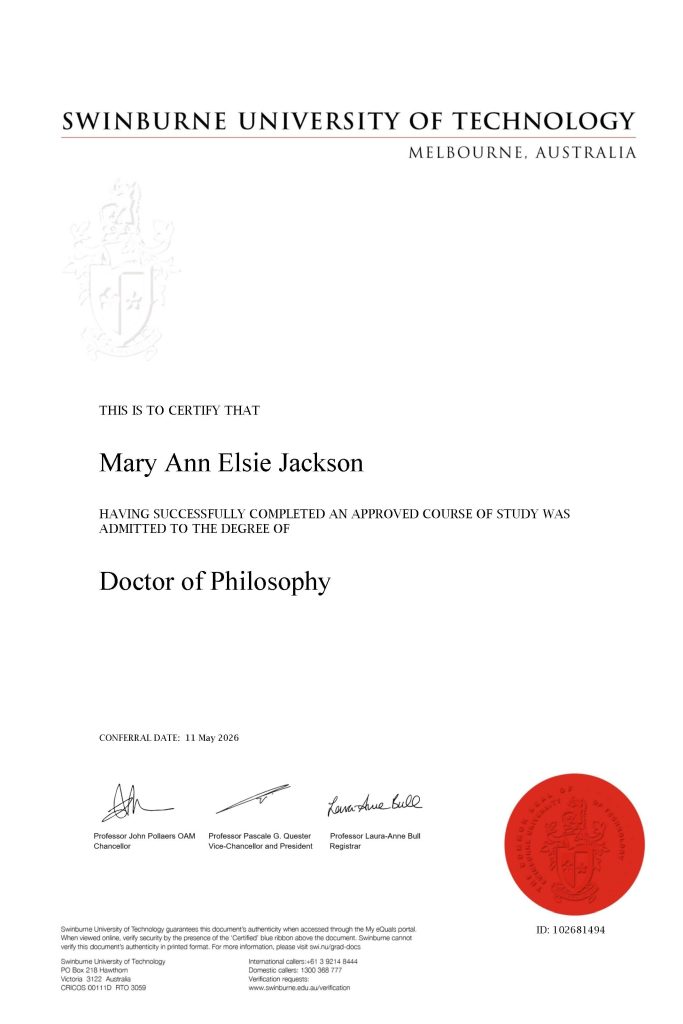
Conferral Citation
“The built environment fails to meet people with disability’s accessibility needs, partly because built environment practitioners lack understanding of real-time neighbourhood journeys. This thesis argues minimalist regulatory compliance is insufficient and proposes a new approach grounded in the social model of disability, complex adaptive systems thinking, transdisciplinarity, and human rights. Presented as a designerly case study, it develops a process to assess neighbourhood-scale accessibility and deepen built environment practitioner understanding. Trialled in inner Melbourne, the process used participatory assessments and follow-up interviews concluding that reframing accessibility as a systemic issue can catalyse meaningful change in architectural education and practice.”
As a PROVOCATION we present the following, slightly modified, excerpt from Mary Ann’s PhD Epilogue.
BY 2030:
- more interaction with people with disability and less reliance on technical compliance in architectural practice, achieved by:
- one or more UMI Process implementations anywhere in inner-middle [insert city of choice].
- people with disability intertwined in architectural education, through enhanced cycles of connection and reflection, achieved by:
- one or more design studios using UMI Process implementation for backgrounding designing accessibly, at one or more universities in [insert city of choice].